Exploratory Analysis of Micro-Scale Temperature Variations For Forensic Entomology Applications
An exploratory study of temperature variability in a small-scale heterogeneous environment, with implications for forensic entomology and post-mortem interval (PMI) interpretation.
Researchers:
- Nurin Liyana M. Syaifurazi
- Raja M. Zuha (rmzuha@ukm.edu.my)
Overview
Temperature is a critical variable in forensic entomology, directly influencing insect development rates and post-mortem interval (PMI) estimation. However, temperature is often treated as spatially homogeneous, despite real environments exhibiting fine-scale thermal heterogeneity. This project presents an exploratory analysis of temperature variations recorded using multiple data loggers deployed within a small, heterogeneous environment. The study focuses on diurnal patterns, spatial gradients, and inter-logger variability, with reference to a nearby meteorological station. This repository is intended as a methodological and exploratory analysis, not a finalized predictive model.
Research Objectives
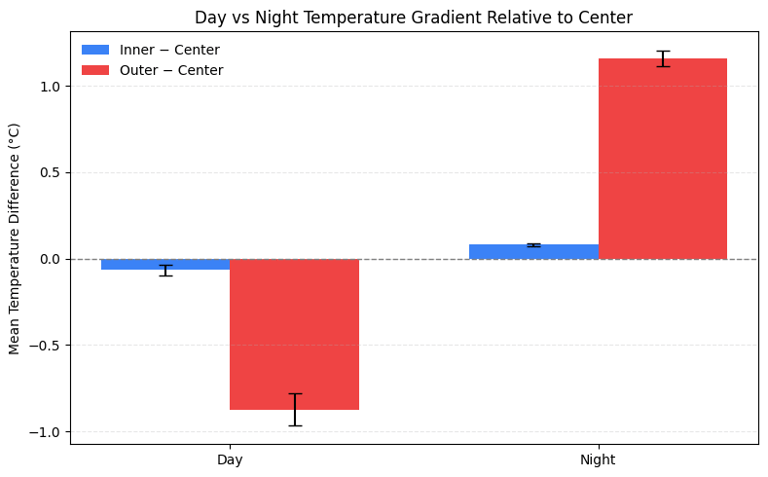
- Explore diurnal temperature gradients within a small spatial scale
- Quantify variability between multiple temperature data loggers
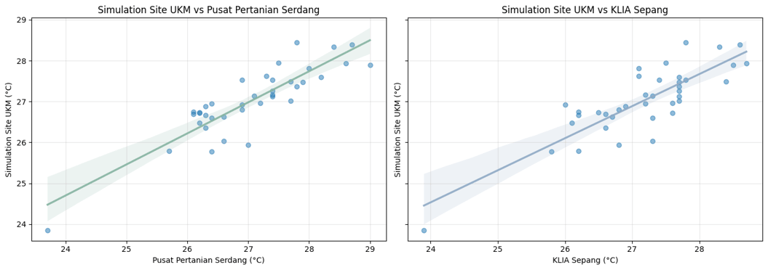
- Compare micro-environmental temperatures with meteorological station records
- Assess implications of thermal heterogeneity for forensic entomology applications
Data Description
The dataset consists of temperature time-series collected from:
- Multiple environmental data loggers deployed within a localized area
- A meteorological station used as a reference for broader ambient conditions
Temperature readings were recorded continuously and analyzed at both daytime and nighttime intervals to capture diurnal dynamics.
> Raw data files are not included in this repository.
Analysis Workflow
The analysis is structured as a sequence of Jupyter notebooks, each addressing a specific analytical question.
Notebook Overview
## 00 — Data Overview
- Initial data loading and inspection
- Timestamp parsing and basic cleaning
- Preliminary visualization of temperature time-series
## 01 — Diurnal Temperature Gradient
- Separation of data into day and night periods
- Examination of diurnal temperature patterns
- Analysis of spatial temperature gradients within the study area
## 02 — Data Logger Temperature Variations
- Comparison of temperature readings across individual loggers
- Quantification of inter-logger variability
- Statistical exploration of differences between logger positions
## 03 — Meteorological Station Comparison
- Comparison between on-site data loggers and meteorological station data
- Assessment of agreement and divergence
- Implications for using station data as a proxy in forensic contexts
Methods (High-Level)
- Exploratory data analysis (EDA)
- Time-series visualization
- Day–night stratification of temperature data
- Non-parametric statistical comparisons where appropriate
- Emphasis on descriptive and comparative analysis rather than prediction
All analyses were performed in Python using Pycharm.
Key Observations (Exploratory)
- Detectable temperature differences exist within a small spatial scale
- Diurnal patterns influence both magnitude and variability of temperature
- Individual data loggers may record systematically different temperature profiles
- Meteorological station data may not fully represent micro-environmental conditions
These findings highlight the importance of considering micro-scale thermal variability in forensic entomology interpretations.
Limitations
- Exploratory study with limited spatial and temporal scope
- No insect developmental data incorporated at this stage
- Findings are descriptive and not intended for direct PMI estimation
Future Directions
- Integration with insect development or colonization data
- Expansion to multiple environments and seasons
- Development of correction or adjustment frameworks for PMI estimation
- Formal statistical modeling of micro-scale thermal effects
Intended Use
This repository is intended for:
- Exploratory research
- Methodological development
- Educational and portfolio demonstration
It is not intended as a production-ready forensic decision system.
License
This project is shared for academic and research purposes.
Please cite appropriately if reused or adapted.
Contact rmzuha@ukm.edu.my for more info.
Acknowledgement
This work builds upon standard practices in forensic entomology, environmental monitoring, and open-source scientific computing.
Readme
Preview